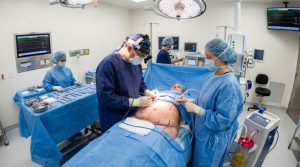

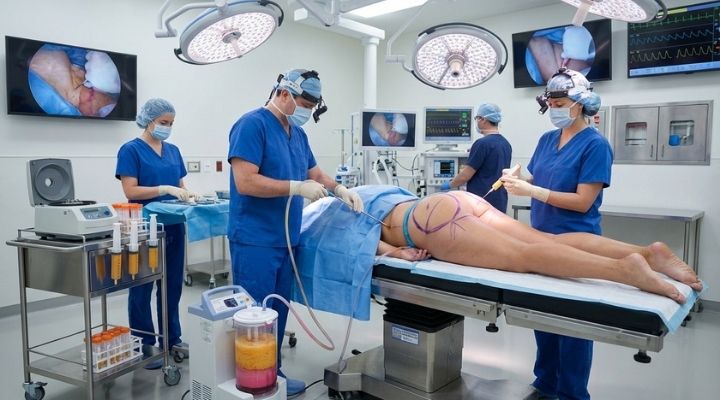
A Brazilian butt lift (BBL) reshapes two areas of your body at once — removing unwanted fat from the abdomen through liposuction, flanks, or thighs and transferring it to the buttocks for a fuller, rounder shape. Unlike implants, a BBL uses your own tissue, which means the results look and feel natural when performed by a skilled surgeon.
BBL is now one of the most requested body contouring procedures worldwide. According to the International Society of Aesthetic Plastic Surgery (ISAPS), gluteal fat grafting procedures grew by 77% between 2015 and 2023. Dr. Elvan Bayraktar performs BBL surgery at her accredited clinic in Istanbul, combining liposuction artistry with meticulous fat transfer technique. Here is exactly how the procedure works from start to finish.
Preoperative Preparation
Your BBL journey begins well before the operating room. During your consultation, Dr. Bayraktar evaluates your body fat distribution to determine whether you have enough donor fat for a meaningful transfer. Most patients need a minimum of 500 to 800 cc of harvestable fat — roughly the amount found in the abdomen and flanks of a person with a BMI between 22 and 32.
If you are very lean (BMI under 20), you may not have sufficient fat for the transfer, and alternative options like gluteal implants may be discussed. Two to four weeks before surgery, you will stop blood-thinning medications and supplements, quit smoking, and complete preoperative blood work and medical clearance.
The night before surgery, you will fast (no food or drink after midnight) and prepare loose, comfortable clothing for the ride home — you will not be sitting on your buttocks for several weeks after the procedure.
Step 1: Anesthesia
BBL is performed under general anesthesia in most cases, meaning you will be completely asleep and feel no pain. The procedure typically takes 2 to 4 hours depending on the volume of fat being transferred and the number of liposuction areas. For smaller volume transfers, some surgeons offer the procedure under sedation with local anesthesia, though this is less common.
Dr. Bayraktar operates in a fully accredited surgical facility with board-certified anesthesiologists monitoring your vital signs throughout the procedure. Safety protocols include continuous blood pressure, heart rate, and oxygen monitoring, as well as DVT prevention measures.
Step 2: Fat Harvesting (Liposuction)
The first surgical phase involves removing fat from donor areas through liposuction. Common harvest sites include the abdomen, flanks (love handles), lower back, thighs, and sometimes the upper arms. The surgeon makes small 3 to 5 mm incisions in inconspicuous locations and inserts a thin cannula connected to a suction device.
Tumescent liposuction is the standard technique: a solution of saline, lidocaine (local anesthetic), and epinephrine (to reduce bleeding) is injected into the donor areas before fat extraction. This loosens the fat cells, numbs the area, and minimizes blood loss. The surgeon moves the cannula in a fan-shaped pattern to extract fat evenly and avoid contour irregularities.
In a typical BBL, 2 to 5 liters of fat are harvested — though not all of this will be transferred. The dual benefit is clear: you lose stubborn fat from areas you want slimmer while gaining volume where you want it most.
Step 3: Fat Purification
Raw liposuction aspirate contains a mixture of fat cells, blood, oil from damaged cells, and tumescent fluid. This mixture must be processed before injection. Purification separates the healthy, intact fat cells from the damaged material.
Three main purification methods are used in modern BBL surgery. Centrifugation spins the fat at controlled speeds (typically 3,000 RPM for 3 minutes) to separate it into layers — oil on top, purified fat in the middle, and fluid at the bottom. Decantation allows gravity to separate the layers naturally. Filtration passes the fat through a mesh to remove fluid and debris.
Each method has proponents, but centrifugation and closed filtration systems tend to yield the highest concentration of viable fat cells. About 60 to 70% of the harvested fat is suitable for transfer after purification. The quality of this step directly impacts how much fat survives long-term in its new location.
Step 4: Fat Injection into the Buttocks
This is the step that defines the BBL result. Using blunt-tipped cannulas, the surgeon injects purified fat into the buttock area in multiple thin layers and at various depths within the subcutaneous tissue (the layer between skin and muscle).
A critical safety principle: fat must be injected into the subcutaneous plane only — never into or beneath the gluteal muscle. Intramuscular injection significantly increases the risk of fat embolism, a potentially fatal complication where fat enters the bloodstream through large veins within the muscle. The Aesthetic Surgery Education and Research Foundation (ASERF) issued updated safety guidelines in 2018 emphasizing subcutaneous-only injection, which reduced BBL mortality rates from 1 in 3,000 to an estimated 1 in 15,000 procedures.
The surgeon injects small volumes (1 to 3 cc per pass) while moving the cannula continuously, creating a three-dimensional network of fat micro-deposits. This “micro-droplet” technique maximizes the contact between injected fat cells and the surrounding blood supply, improving fat survival rates. Typically, 400 to 900 cc of purified fat is injected per buttock, though this varies based on patient anatomy and goals.
What Happens to the Transferred Fat?
Not all transferred fat survives. Your body reabsorbs a percentage of the injected fat cells during the first 3 to 6 months as the tissue establishes a new blood supply. On average, 60 to 80% of transferred fat survives permanently — meaning the fat cells that remain at 6 months will stay with you for life (unless you experience significant weight loss).
This is why surgeons typically “over-inject” slightly — adding 10 to 20% more volume than the target result to account for predictable resorption. Your buttocks will appear fuller in the first few weeks and gradually settle to a slightly smaller but permanent size by month 6.
Fat survival depends heavily on technique (micro-droplet injection yields better survival), the quality of fat processing, and your post-operative behavior. Sitting directly on the buttocks in the first 2 to 3 weeks compresses the newly transferred fat and can kill cells before they establish blood supply — which is why strict sitting restrictions are enforced.
Recovery Overview
BBL recovery is unique because of the no-sitting rule. For the first 2 to 3 weeks, you cannot sit directly on your buttocks. You can lie on your stomach, lie on your side, or stand. When sitting is unavoidable (using the toilet, eating), a BBL pillow that offloads pressure from the buttocks onto the thighs is used.
Compression garments are worn on the liposuction areas 24 hours a day for 4 to 6 weeks. Swelling in the buttocks and donor areas peaks in the first week and gradually subsides over 2 to 3 months. Most patients return to desk work (with a BBL pillow) within 2 to 3 weeks and resume exercise at 6 to 8 weeks.
Frequently Asked Questions
How long does a BBL last?
The fat cells that survive the transfer (60-80%) are permanent. They behave like fat elsewhere in your body — they grow with weight gain and shrink with weight loss. Maintaining a stable weight preserves your results long-term.
Is BBL safe?
BBL safety has improved dramatically since the adoption of subcutaneous-only injection guidelines. When performed by a qualified surgeon following current safety protocols, the risk of serious complications is very low. The key risk — fat embolism — has been reduced by over 80% with modern techniques.
How much fat do I need for a BBL?
Most patients need 500-900 cc of purified fat per buttock for a visible result. To harvest this, you typically need enough body fat for liposuction — generally a BMI of 22 or higher. Very lean patients may not be suitable BBL candidates.
Can I sit after a BBL?
No direct sitting on the buttocks for 2-3 weeks. After that, use a BBL pillow for another 4-6 weeks. By 8 weeks, most patients can sit normally. Following these restrictions is critical for fat survival.
How is a BBL planned in Istanbul?
The plan for a BBL is determined individually after a consultation, based on the scope of the procedure and your needs. Dr. Bayraktar offers all-inclusive packages; please contact our clinic for personalized information.